Cart
No products in the cart.
A smooth bike path can make a trail shoe feel clunky. A rocky, wet descent can make a road shoe feel like a bad decision fast. That is the real answer to trail shoes vs road shoes: pick for the ground under you, not the label on the box.
We see people buy trail shoes because they look tougher, then wear them for every errand and easy road run. We also see runners take soft road shoes onto muddy roots and wonder why their feet are sliding around. Neither shoe is better across the board. They are built for different jobs.
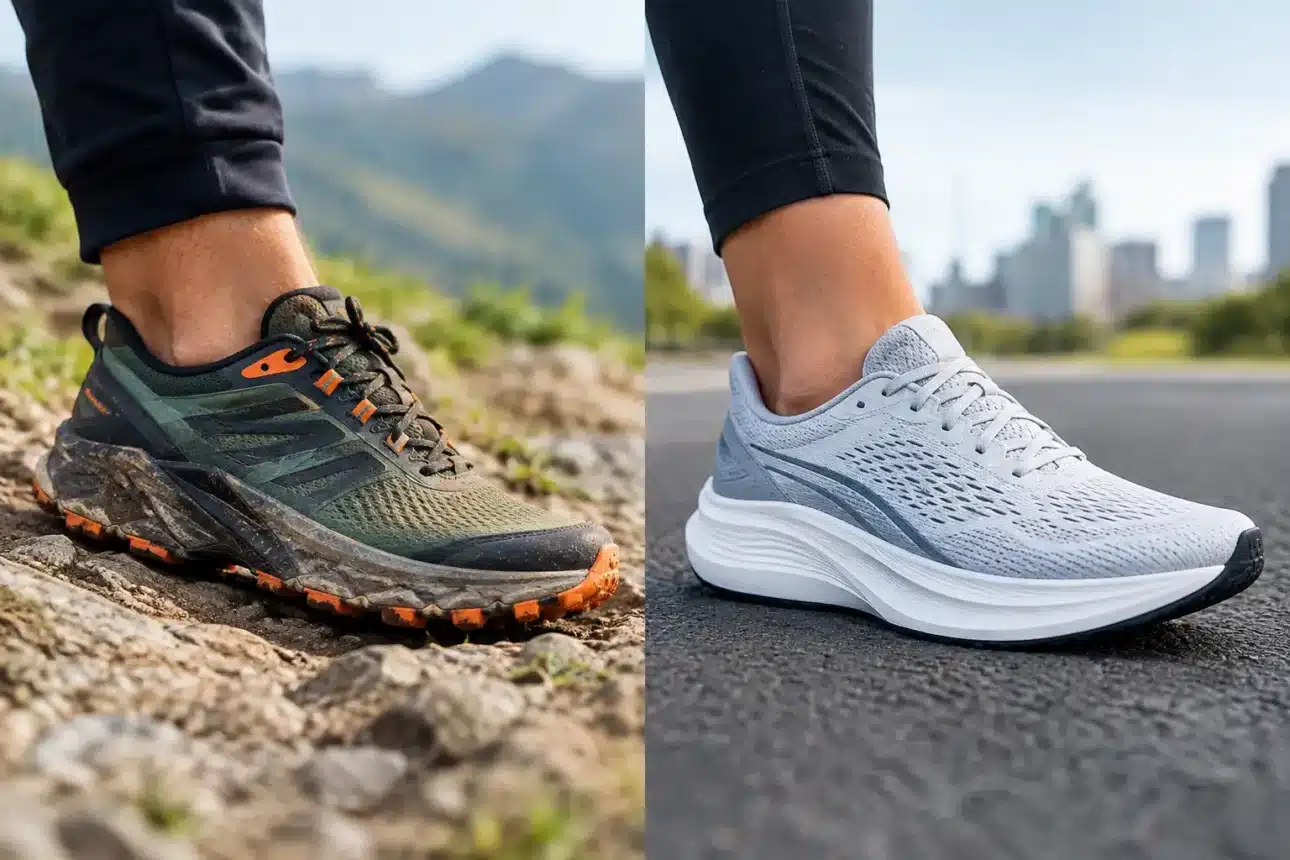
Road shoes are made for hard, predictable surfaces like pavement, sidewalks, treadmills, and packed paths. Their job is to soften the repeated impact of flat ground and keep your stride moving without extra weight underfoot. Most have smoother rubber outsoles, lighter uppers, and cushioning that feels consistent mile after mile.
Trail shoes are made for surfaces that fight back. Dirt, gravel, loose rocks, roots, mud, wet leaves, and uneven hills all demand more grip and more protection. A trail shoe usually has deeper lugs on the outsole, a tougher upper, and a firmer platform that helps keep your foot steady when the ground is not.
That does not mean trail shoes are stiff bricks or that road shoes are fragile. Plenty of modern trail runners feel cushioned and quick. Plenty of road models have tough rubber that lasts. But the basic design priorities stay the same: road shoes want a smooth ride, while trail shoes want control.
If most of your miles happen on pavement, buy road shoes. We would not overthink it.
Road shoes are shaped for repetitive forward movement. The outsole is flatter, the foam is often softer, and the shoe flexes in a way that works well on sidewalks and asphalt. That can make an easy three-mile run feel less harsh, especially if you are getting back into running or spend hours walking around town.
A trail outsole can feel rough and loud on pavement. Those deep lugs push against hard ground instead of biting into it. You will still get from point A to point B, but the ride is less natural and the tread can wear down quicker.
Road shoes do not need rock plates, thick toe bumpers, or aggressive tread. Less armor means less weight. That matters when you are running longer distances, trying to keep your stride relaxed, or just hate the feeling of a heavy shoe on your foot.
For daily walking, commuting, standing at work, or treadmill sessions, a road shoe is also the cleaner pick. It looks less technical and feels more at home on concrete floors than a mud-ready trail runner.
A good road shoe can cover a lot: morning jogs, dog walks, travel days, gym warmups, and long shifts where your feet take a beating. If you want one athletic pair for mostly urban use, this is where we would spend the money.
Just do not assume the softest shoe is automatically the best. Some runners love a plush feel. Others feel more stable in a moderate, firmer daily trainer. Try to match the shoe to what feels good after an hour, not what feels bouncy for thirty seconds in a mirror.
Trail shoes earn their keep as soon as the surface gets loose, steep, or unpredictable.
The lugs on a trail outsole act like small rubber teeth. They dig into dirt and help shed mud. On dry, hard-packed trails, you may not need the deepest lugs. On wet, sloppy routes, shallow tread is not enough.
This is where road shoes lose badly. Their flatter outsoles are fine on a dry gravel path for a short stretch. Add rain, off-camber dirt, or loose stones, and they can slide. We do not recommend gambling on that if trails are a regular part of your week.
A trail shoe often has a reinforced toe area to block the pain of catching a rock. Many also use denser foam or a rock plate under the forefoot. That layer spreads out the pressure from sharp stones, so every bad step does not feel like you landed on a bottle cap.
More protection is useful, but it comes with a trade-off. The shoe can feel firmer and less flexible than a road model. For technical trails, that is worth it. For flat neighborhood loops, it is overkill.
Trail uppers tend to be more structured, especially around the midfoot and heel. When you move sideways on uneven terrain, you do not want your foot swimming around inside the shoe. A secure fit helps you react to the trail instead of fighting your footwear.
Do not mistake tight for secure. Your toes still need room to spread and move, especially on descents. If your big toe hits the front of the shoe while walking downhill, size up or pick a roomier model. Black toenails are not a badge of honor.
Yes, if your routes are mixed but not extreme. A road-to-trail shoe is the sensible middle ground for runners who leave the neighborhood, cut through a park, and hit a few miles of dry dirt before heading home. These shoes usually have moderate lugs, enough grip for easy trails, and cushioning that does not feel awkward on pavement.
But do not make a hybrid your only answer if you run serious trails or serious road mileage. A road-to-trail outsole will not grip like a real trail shoe in deep mud. It also will not feel as smooth as a dedicated road trainer on long pavement runs. It is a compromise, and a good one only when your running actually demands it.
If you run mostly roads with the occasional park trail, pick road shoes. If you run mostly trails with a mile or two of pavement to reach them, pick trail shoes. The route you run most often should make the call.
Start with your usual surface. Not the scenic route you plan to run once a month. The route you actually take when it is Tuesday, you are tired, and you have 40 minutes.
Then look at the terrain. Smooth crushed gravel and packed dirt need far less shoe than rocky, root-filled singletrack. For easy trails, a lighter trail model or hybrid works well. For steep, wet, technical ground, choose a shoe with deeper lugs, a stable base, and solid toe protection.
Next, think about fit. Your heel should stay put without rubbing. Your midfoot should feel held, not squeezed. Leave roughly a thumb’s width between your longest toe and the front of the shoe. Feet swell on longer runs, and downhill trail running pushes them forward.
Finally, be honest about cushioning. If you want a soft, forgiving feel for pavement, road shoes give you more options. If you want to feel connected to the ground and stay steady on uneven dirt, a lower, firmer trail shoe may feel better. There is no prize for choosing the most cushioned or most aggressive model.
Do not wait until there is a hole in the upper. Check the outsole first. On road shoes, worn-down rubber and foam that feels flat or lopsided are the usual signs. On trail shoes, look for rounded-off lugs, peeling outsole sections, and a midsole that no longer feels stable on uneven ground.
Mileage matters, but it is not a magic number. Your weight, running form, surfaces, and how often you wear the shoes all change the timeline. A pair used for occasional runs can last a long time. A pair worn daily for runs, walks, and errands gets cooked faster.
At Sneaker Loft, we keep it simple: buy the shoe that matches the miles you really do. Road shoes for pavement. Trail shoes for dirt. If your route genuinely mixes both, grab a hybrid and get moving. Your feet will tell you the rest.