Cart
No products in the cart.
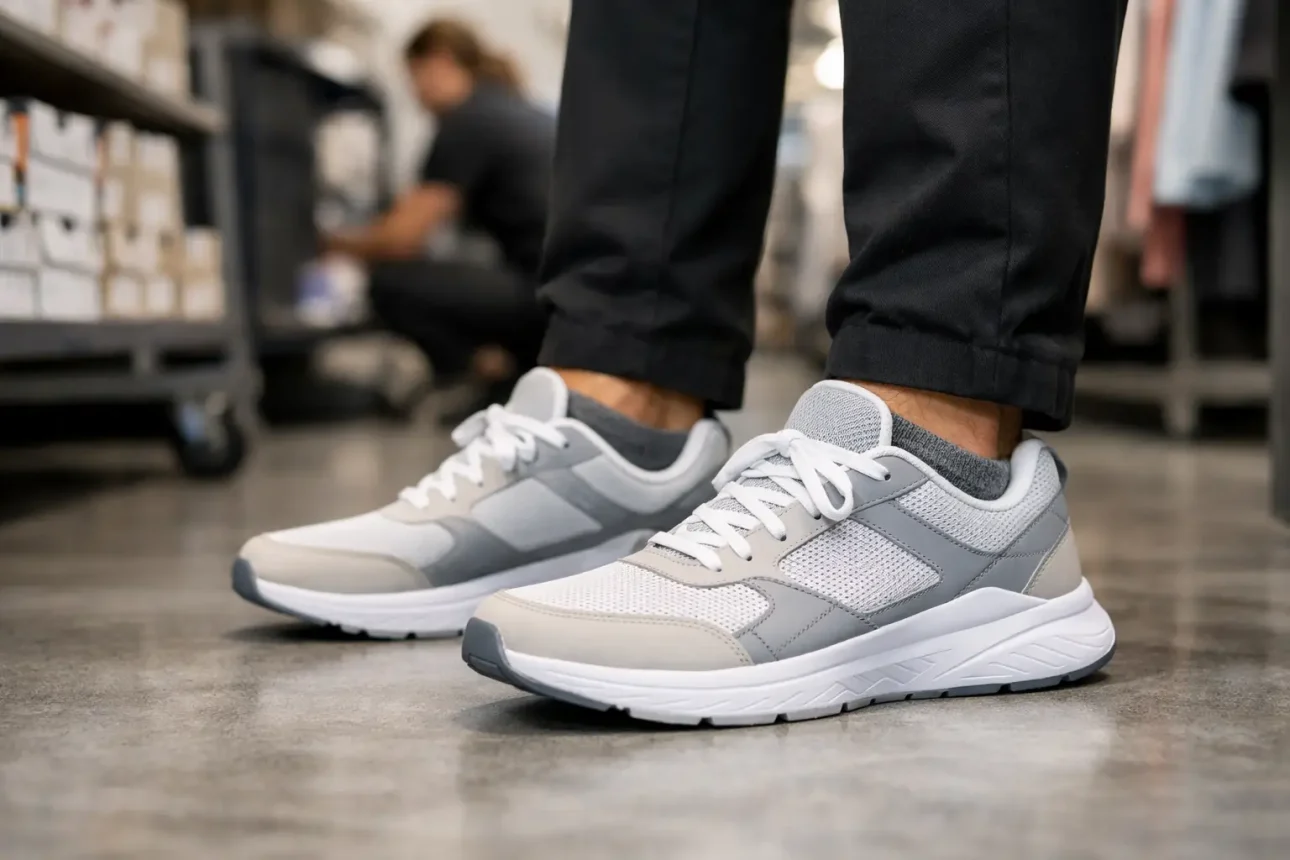
Your feet usually tell the truth around hour six. Not when you first lace up. Not when you walk from the couch to the car. We’re talking about that retail shift stretch when the floor feels harder, your lower back starts talking, and cheap sneakers get exposed fast. If you’re searching for the best sneakers for retail workers examples, you don’t need a giant tech breakdown. You need pairs that still feel decent when the stockroom run turns into your hundredth lap of the day.
Retail work is rough on shoes in a very specific way. You’re standing, but not really still. You’re walking, but not in a clean straight line like a run. You’re pivoting, stopping hard, carrying boxes, crouching, climbing short ladders, then standing at a register under bright lights for another hour. That mix kills flat midsoles and flimsy uppers.
We’ll keep this simple. The best retail sneaker is usually not the coolest one and definitely not the flattest one. A good pair for long shifts needs enough cushioning to take the edge off hard floors, enough support to stop your feet from folding inward late in the day, and enough grip that polished store floors don’t feel sketchy.
Breathability matters too, especially if you’re indoors all day under heat and lights. But don’t get carried away with super-thin uppers if you work stock as much as sales. They feel airy, sure, but some of them get chewed up fast. Retail shoes need to hold up, not just feel soft for the first week.
And yes, looks still matter. If you wear all black at work, a giant neon running shoe might be a bad move even if it feels amazing. That’s the trade-off. Sometimes the best-feeling pair isn’t the one you can actually wear on the floor.
If your shifts are long and the floors are brutal, this is one of the easiest picks. The Bondi is max-cushioned, stable enough for all-day wear, and built for people who want impact protection more than speed. It’s not subtle. It’s got that big-stack look. But after eight or ten hours, most people stop caring.
We like it for workers who spend more time standing than sprinting around. Cashiers, floor staff, beauty counters, customer service desks – this one makes sense there. The trade-off is obvious. It’s bulkier than a lot of sneakers, and if you want a sleek fashion shoe, this isn’t it.
The Ghost is one of those shoes we keep coming back to because it rarely does anything stupid. Cushioning is balanced. The fit works for a lot of feet. It feels smooth, not mushy. For retail workers who walk a lot and don’t want a giant oversized midsole, this is a safe bet.
It’s also easier to wear with regular work clothes than some chunky runners. Not dressy, but clean enough. If you need serious arch support, you may want something more structured. But for a lot of people, the Ghost hits the sweet spot between soft and stable.
This is the grown-up pick. Expensive, yes. Worth it for the right person, also yes. The 990 line has a reputation for a reason. It’s supportive, durable, and comfortable without feeling sloppy underfoot. If you work full-time in retail and burn through cheap shoes every few months, this can be the smarter buy.
It also helps that the style works off the clock. That matters if you don’t want a shoe that screams gym-only. The downside is price, and not everyone loves the firmer ride. If you want cloud-soft foam, look elsewhere.
The Gel-Nimbus is a strong pick if your main complaint is that your feet feel beat up by the end of the day. It has a soft, protective ride and does a good job taking pressure off hard surfaces. For department store workers or anyone doing long indoor shifts, that can be a real difference.
What we like is that it doesn’t just feel plush for five minutes. It usually stays comfortable through a full day. What we don’t like is that some versions can feel a little too soft if you move fast or need a more planted feel when carrying stock.
This one works well if you want comfort but don’t want the full orthopedic look. The Vomero has enough cushion for long days and usually feels lighter on foot than some of the max-stack options. It’s a good middle ground if you split time between standing still and moving constantly.
Nike fit can be hit or miss depending on your foot shape. If your feet run wide, don’t assume this will be your answer. Try carefully. But if the shape works for you, it’s one of the cleaner-looking retail shoes that still earns its keep on long shifts.
We’ll be honest. Ultraboost gets overhyped sometimes. People act like it solves everything. It doesn’t. But for retail workers who want a soft, flexible shoe and care about style, it still has a place.
It feels good underfoot and looks sharper than most work-friendly running shoes. The weak point is support. If your feet roll inward or you need a more stable platform, don’t make this your only pair. For lighter shifts or workers who don’t need much structure, it can still be a solid choice.
If you want softness without going full marshmallow, the 1080 deserves a look. It’s cushioned, roomy in many versions, and friendlier for people whose feet swell during long shifts. That matters more than people think. A shoe that feels great at 9 a.m. can feel cramped and annoying by late afternoon.
This is one we like for workers doing constant laps around the store. It’s not as dress-friendly as some lifestyle models, but for pure all-day comfort, it’s up there.
The Clifton is the Bondi’s less bulky cousin. Still cushioned. Still comfortable. Just easier to wear if you don’t want a giant shoe on your foot. For a lot of retail workers, this is the better Hoka pick because it balances comfort and everyday wearability better.
The catch is durability can depend on how hard you are on shoes. If you drag your feet or beat up the toe area in stockrooms, keep an eye on wear. Still, for long shifts, this one usually gets more right than wrong.
Flat fashion sneakers are the first trap. They look clean. They usually feel fine for two hours. Then your feet pay for it. Classic low-profile lifestyle pairs, skate-style soles, and super-thin retro trainers are not built for ten-hour retail shifts. Save them for weekends.
We’d also skip anything too soft and unstable if you spend part of your job carrying boxes, climbing stairs, or turning fast in tight aisles. Plush sounds great until the shoe feels sloppy underneath you. That’s why the softest option isn’t always the best option.
If you mostly stand in one zone, pick more cushion. Bondi, Gel-Nimbus, and 1080 all make sense there. If you walk nonstop and want something smoother and less bulky, Ghost, Clifton, and Vomero are better fits.
If your store dress code is strict and you need something cleaner-looking, the 990 series is one of the easiest answers. If you care most about style and want something that still works for a shift, Ultraboost can do the job, but only if your feet don’t need extra structure.
And if your current shoes feel fine until the second half of your day, that’s usually a support or sizing problem, not just a cushioning problem. A softer shoe won’t always fix that. Sometimes you need a more stable one or a roomier fit.
Cheap retail shoes are expensive in the long run. That sounds dramatic, but it’s true. If a pair dies in three months, flattens out fast, or makes every shift worse, you didn’t save money. You just spread the pain out.
That doesn’t mean you need the priciest pair on the wall. It means you should stop buying shoes that only win in the mirror. We’d rather see you in one solid pair from Brooks, Asics, Hoka, Nike, Adidas, or New Balance than two bargain pairs that tap out before the season ends.
If you work retail full-time, treat your shoes like part of the job. Because they are. The right pair won’t make your shift fun, but it can stop your feet from hating you before closing time.