Cart
No products in the cart.
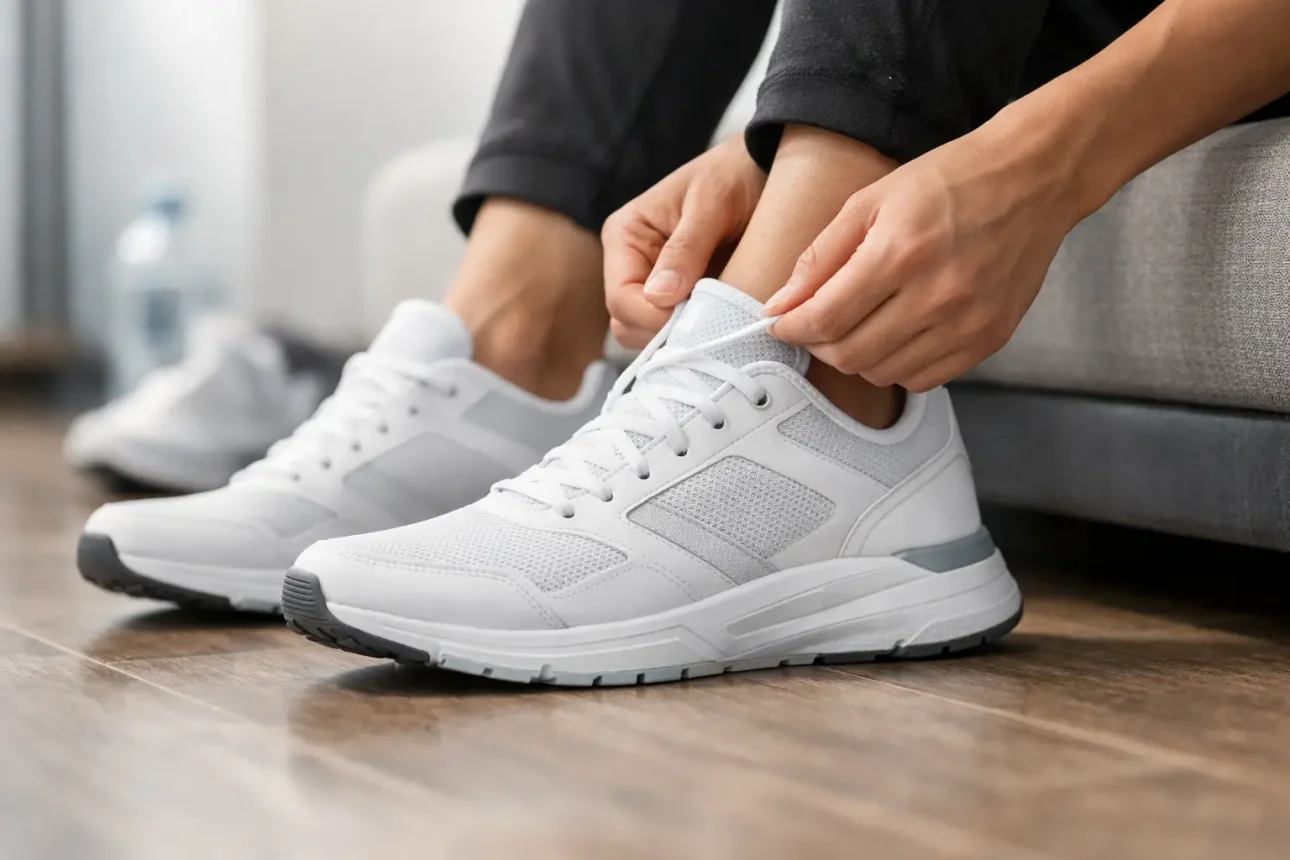
A sneaker can look perfect in the box and still ruin your day by lunch. Your heel slips. Your toes hit the front. The top of your foot feels squeezed. That is why a guide to sneaker fit matters more than a brand logo or a half-price tag. The right pair should feel good when you first put it on, then keep feeling good after a normal day of walking, standing, commuting, or running errands.
We are not going to tell you every sneaker feels different and leave you there. They do feel different. But there are clear checks that stop you from buying the wrong pair.
Most people know their usual sneaker size. That is useful, but it is not a rule. Feet change over time. They can spread out a little, and they often swell through the day. If you only try shoes on first thing in the morning, a pair that feels fine then may feel tight at 5pm.
Measure both feet while standing, ideally later in the day. Use the larger foot as your reference. If one foot is a half size longer, buy for that foot. Do not force the larger foot into a smaller shoe just because the other one has room.
Shoe size is also not universal across brands. A men’s 10 in one line can feel noticeably longer or narrower than a men’s 10 in another. Even within the same brand, a slim racing shoe and a cushioned walking shoe may fit differently. Treat your familiar size as the starting point, not the answer.
You need a little room in front of your longest toe. Usually, that means roughly a thumb’s width between the toe and the end of the shoe when you are standing. Not a giant empty space. Not your toe pressed against the front.
Your longest toe is not always your big toe. For plenty of people, the second toe reaches farther. Check the shoe based on the toe that goes furthest forward.
Walk around for a few minutes. Then pay attention to what happens as your foot rolls forward. Your toes should not jam into the front. If they do, skip the pair. A shoe that is short does not become longer after a break-in period.
Too much length has its own problem. Your foot can slide forward, your heel can lift, and the shoe starts feeling clumsy. If you are tightening the laces as hard as possible just to stop your foot moving, the size is probably off.
This is one of the worst sneaker-buying habits. Some materials relax a bit around the sides. Soft leather may give more than a tightly woven mesh upper. But the sole length will not change, and a narrow shoe will not suddenly turn into a wide one.
A sneaker can feel secure without feeling restrictive. There is a difference. Secure means your foot stays in place. Restrictive means you can feel pressure on your toes, the sides of your forefoot, or the top of your foot before you have even left the house.
Length gets all the attention. Width is where a lot of bad fits happen.
If the upper bulges out over the sides of the midsole, your foot is probably too wide for the shoe. If your little toe feels crushed or the shoe leaves deep marks after a short walk, do not blame your feet. The shoe is too narrow.
On the other side, a shoe that is too wide can let your foot move around. That creates rubbing and makes your stride feel sloppy. You want the upper to sit close around the middle of your foot, with enough space at the front for your toes to spread naturally.
Some sneaker lines run naturally narrow. Others have a rounder toe box or come in multiple widths. If you know you need more room, do not keep buying standard-width shoes and hoping a different colorway will fit better. Pick models with a wider shape from the start.
The best fit depends on what you plan to do in the shoe. We would not fit a casual fashion sneaker the same way we fit a running shoe.
Pick enough cushioning to take the edge off hard floors, but do not ignore stability. A very soft shoe can feel nice for five minutes and feel wobbly after hours on your feet. Your heel should sit securely, the midfoot should feel supported, and the forefoot needs room.
If you work long shifts, skip flat, thin sneakers unless you already know they work for you. They may look clean, but looks do not help when your feet are cooked by the end of the day.
Running shoes need a secure heel and a locked-in midfoot. Your foot moves more when you run, and it can slide forward on downhills. Keep that thumb’s width at the toe, especially if you run longer distances.
Do not chase a super-tight fit because it feels fast in the store. It often feels terrible once your feet warm up. A running shoe should feel planted, not squeezed.
Lifestyle sneakers can fit closer than a running shoe if you are mostly walking short distances. Still, your toes need room and your heel should not pop up with every step. A stiff leather pair may soften around the foot over a few wears, but it should not hurt on day one.
Some classic sneakers are famous because they look sharp, not because they are built for twelve hours on concrete. We like style, but we also like being able to walk home comfortably. Know what you are buying.
A little movement at the heel can be normal in a new sneaker, especially one with a firm heel collar. Constant slipping is not.
First, make sure the length is right. A shoe that is too long often slips no matter how you lace it. Then try a runner’s loop, also called heel-lock lacing, using the top eyelets. It can pull the collar closer around your ankle without crushing the front of your foot.
If that does not help, the shoe shape probably does not match your heel. Do not keep fighting it. Different models have different heel cups, and some just will not hold your foot well.
Thin no-show socks, thick crew socks, running socks, and winter socks all change the fit. It sounds obvious, but people still try sneakers on with one type of sock and wear them with another.
Bring the socks you use most. If you switch between thick and thin socks, fit the shoe with the thicker pair. You can usually fine-tune a slightly roomy sneaker with a thinner sock. You cannot create extra room in a shoe that already feels tight.
Also, wear both shoes. Stand up. Walk on a hard surface if you can. Put your weight on one foot, then the other. A seated try-on tells you almost nothing about whether a sneaker will work through a real day.
Sometimes the warning signs show up after the first proper wear. Do not ignore them.
A short adjustment period is normal with firmer materials. Ongoing pain is not a break-in story. It is a fit problem.
Online sneaker shopping is easy until sizing gets involved. Before wearing a new pair outside, try them indoors on a clean floor. Wear your normal socks and walk around long enough to catch pressure points, heel slip, or toe contact.
Keep the box and packaging until you are sure. The return window is there for a reason. Use it instead of convincing yourself that a bad fit will somehow become fine.
At Sneaker Loft, we pick shoes across running, walking, and everyday style because people need different things from a pair. But the rule stays the same: do not buy a sneaker just because your usual size is available. Buy the size and shape that let your feet relax.
The right sneaker should disappear once you start moving. You should notice the color, the look, maybe the cushioning. You should not spend the day thinking about your toes. If you do, send them back and get the pair that fits.