Cart
No products in the cart.
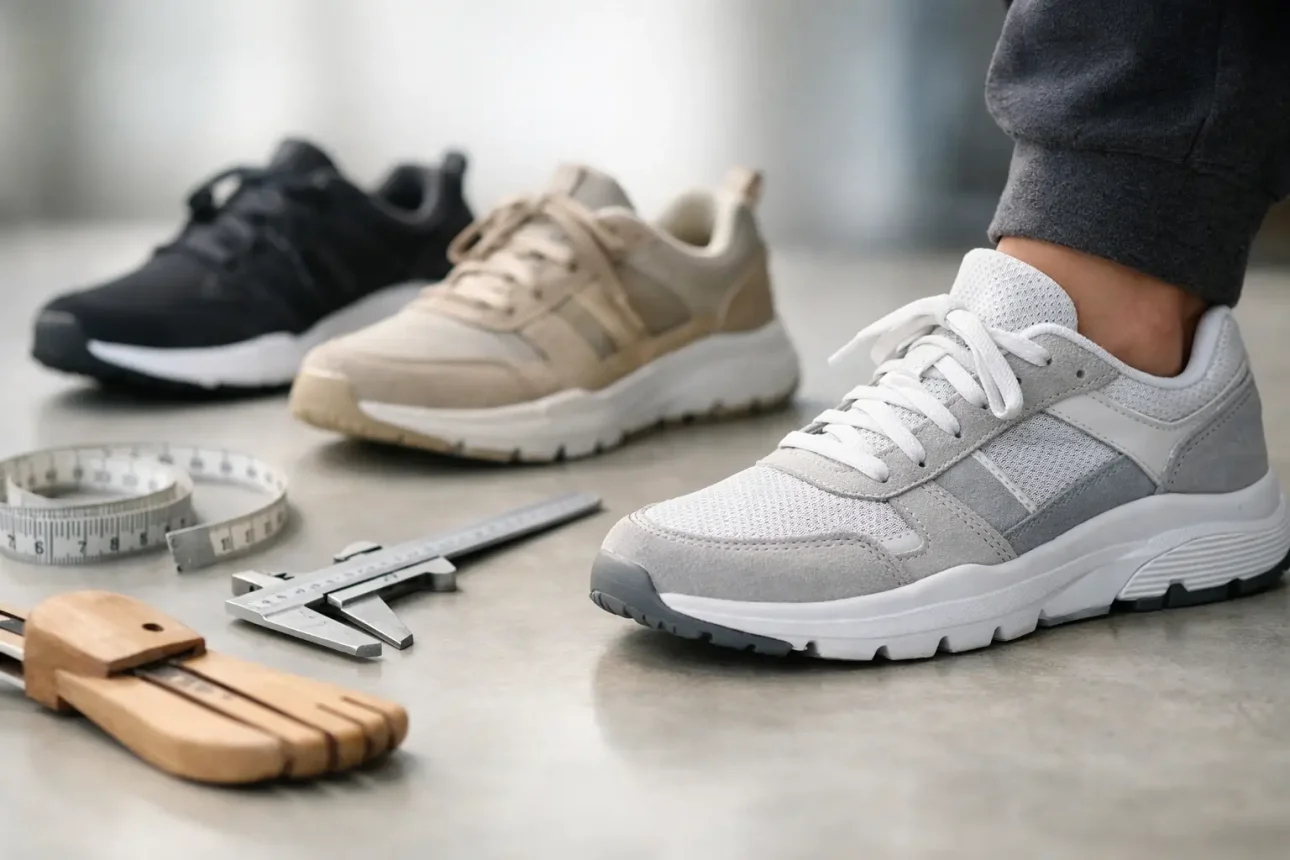
Buying sneakers in the wrong size is a fast way to waste money. One brand says you’re a US 10. Another says 10.5. Then EU sizing shows up, the numbers look familiar, and somehow the shoes still crush your toes. This guide to sneaker size conversion is here to cut through that mess.
Most people think size conversion is simple. It isn’t. A US men’s 9 is not always going to feel the same across Nike, Adidas, New Balance, Hoka, or Asics. The number gets you in the ballpark. The shape of the shoe decides whether you actually want to wear it.
Here’s the issue. Size charts convert length, not fit. That means a chart can tell you that a US men’s 10 usually lines up with a UK 9 and an EU 44. But it can’t tell you whether the toe box runs tight, whether the heel slips, or whether the upper feels stiff right out of the box.
That’s why people get burned shopping online. They trust the conversion table like it’s law. Then the shoes arrive and feel way off.
Brands also don’t keep things perfectly consistent. Nike often runs narrow in a lot of models. New Balance usually gives you a bit more room, and some pairs come in wide options that actually help. Adidas can go either way depending on the model. Hoka tends to feel different from old-school lifestyle sneakers because the platform and shape are built for a different kind of ride. Brooks is usually steady, but even there, not every model fits the same.
So yes, conversion matters. But if you stop there, you’re guessing.
Start with the size you know fits you best in a shoe you actually wear. Not a dress shoe. Not boots. Not that pair you keep because they look good even though they hurt after lunch. Use a sneaker you trust.
If your best-fitting pair is a US men’s 10.5, use that as your anchor. Then convert from there when you shop across regions. In most cases, that lands around a UK 9.5 and an EU 44.5 or 45, depending on the brand.
If you wear women’s sizing, the same rule applies. Anchor yourself to the pair that feels right, then convert outward. In many brands, women’s US sizing is roughly 1.5 sizes up from men’s. So a women’s 10 is often close to a men’s 8.5. Often. Not always. That’s the part people hate, but it’s the truth.
For men’s sneakers, the common rough conversion looks like this: US 8 equals UK 7 and usually EU 41, US 9 equals UK 8 and usually EU 42.5, US 10 equals UK 9 and usually EU 44, and US 11 equals UK 10 and usually EU 45.
For women’s sneakers, a rough version is: US 7 equals UK 5 and around EU 38, US 8 equals UK 6 and around EU 39, US 9 equals UK 7 and around EU 40.5, and US 10 equals UK 8 and around EU 42.
That gets you close. Close is useful. Close is not perfect.
The EU number throws people off the most because it looks more exact. It isn’t. Some brands round up. Some split half sizes differently. A 44 in one brand can feel shorter than a 43.5 in another. If you’re shopping by EU size alone, check yourself before you hit checkout.
If you’re buying for kids, don’t try to wing it. Grade school sizing, little kids’ sizing, and youth conversions vary enough to cause real problems. Feet grow fast, and kids won’t always tell you a shoe feels bad until they’ve already worn it outside.
Measure their feet. Add a little room, but don’t go crazy. Too much extra space means heel slip and awkward walking. Kids do not need “room to grow” if that room turns the shoe into a clown car.
This part matters more than people think. If you don’t know your foot length, you’re relying on memory and luck.
Put a piece of paper on the floor against a wall. Stand on it with your heel lightly touching the wall. Mark the longest point of your foot. Measure from the wall to that mark in centimeters and inches. Do both feet. Use the longer one.
Do this at the end of the day, not first thing in the morning. Feet swell a bit after hours of walking and standing. That’s the version you want to fit.
Wear the kind of socks you plan to use with the shoes. Thin no-show socks and thick gym socks can change the fit more than you’d think.
If you’re between sizes, don’t make the cheap mistake. Go with the brand’s fit notes and the shape of your foot. If you have wide feet, sizing up half a size can help in narrow models. If the shoe already runs long, that same move can leave you sliding around like you’re wearing someone else’s pair.
A clean size conversion means nothing if the shoe shape is wrong for your foot.
If you have a wide forefoot, skip narrow models unless the brand offers a wide version. Don’t talk yourself into “breaking them in” if your toes are packed on day one. Some materials loosen a bit. Most painful toe boxes stay painful.
If your heel slips, the shoe may be too long, too wide in the rearfoot, or just built on a last that doesn’t suit you. Going down a size can fix it. It can also crush your toes. That’s why fit is not just math.
Arch feel is personal too. One person says a shoe feels supportive. Another says it feels intrusive. Neither is wrong. That’s why we always tell people to start with what already works on their feet.
Nike often fits snug, especially in slimmer lifestyle models and some performance pairs. If you already ride the line between sizes, you may need the half size up.
Adidas is mixed. Some pairs fit true. Some feel long. Knit uppers can feel forgiving across the top of the foot, but that doesn’t mean the base of the shoe is roomy.
New Balance is one of the safer picks if you need options. We like that they offer widths in more models than a lot of brands. If standard sneakers usually squeeze you, start there.
Asics and Brooks are often more reliable for people who care about all-day wear, not just looks. Hoka can feel different because of the stack and shape underfoot. Great for some people. Weird for others. If you’re new to that style, don’t assume your usual size will feel familiar.
Puma can run sleek. That’s good if you like a close fit. Bad if your feet spread out by 5 pm.
Size up half a size if the model runs short, your toes are near the end, or you wear thicker socks. Do it if the upper is stiff and the brand already leans narrow.
Size down only if the shoe clearly runs long and your heel is slipping. Even then, be careful. A slightly roomy forefoot is easier to live with than black toenails.
Walk away if you’re trying to force a bad shape to work. We mean it. Some shoes look sharp and wear terribly. If a pair needs special lacing tricks, thin socks, and wishful thinking just to feel okay in the house, skip them.
The biggest mistake is assuming your size is your size everywhere. It isn’t.
The second is using old shoes as proof of fit when those shoes were never right to begin with. A lot of people have been wearing the wrong size for years and don’t know it because they got used to it.
The third is ignoring width. Length gets all the attention, but width wrecks more fits than people admit. If the side of your foot spills over the midsole, that’s not “normal break-in.” That’s the wrong shoe.
And the last one is buying based on hype. If a pair is known for tricky sizing, believe that. Don’t assume your feet are the exception.
Use size conversion as a starting point. Then look at the model, the brand, your foot shape, and what you’ll actually do in the shoe. Standing all day, casual wear, short runs, gym sessions – they don’t all demand the same fit.
A lifestyle sneaker can feel fine a little snug if the materials soften and you’re mostly wearing it out to dinner. A running shoe that feels snug in the toe box is a bad idea from the start. Different use, different tolerance.
If you’re shopping online, keep it simple. Measure your feet. Compare the region sizes. Check whether the model runs short, long, narrow, or wide. Then buy the size that matches reality, not the number you wish you wore.
That’s the whole play. Sneaker size conversion helps, but your feet get the final vote. Trust them over the label.