Cart
No products in the cart.
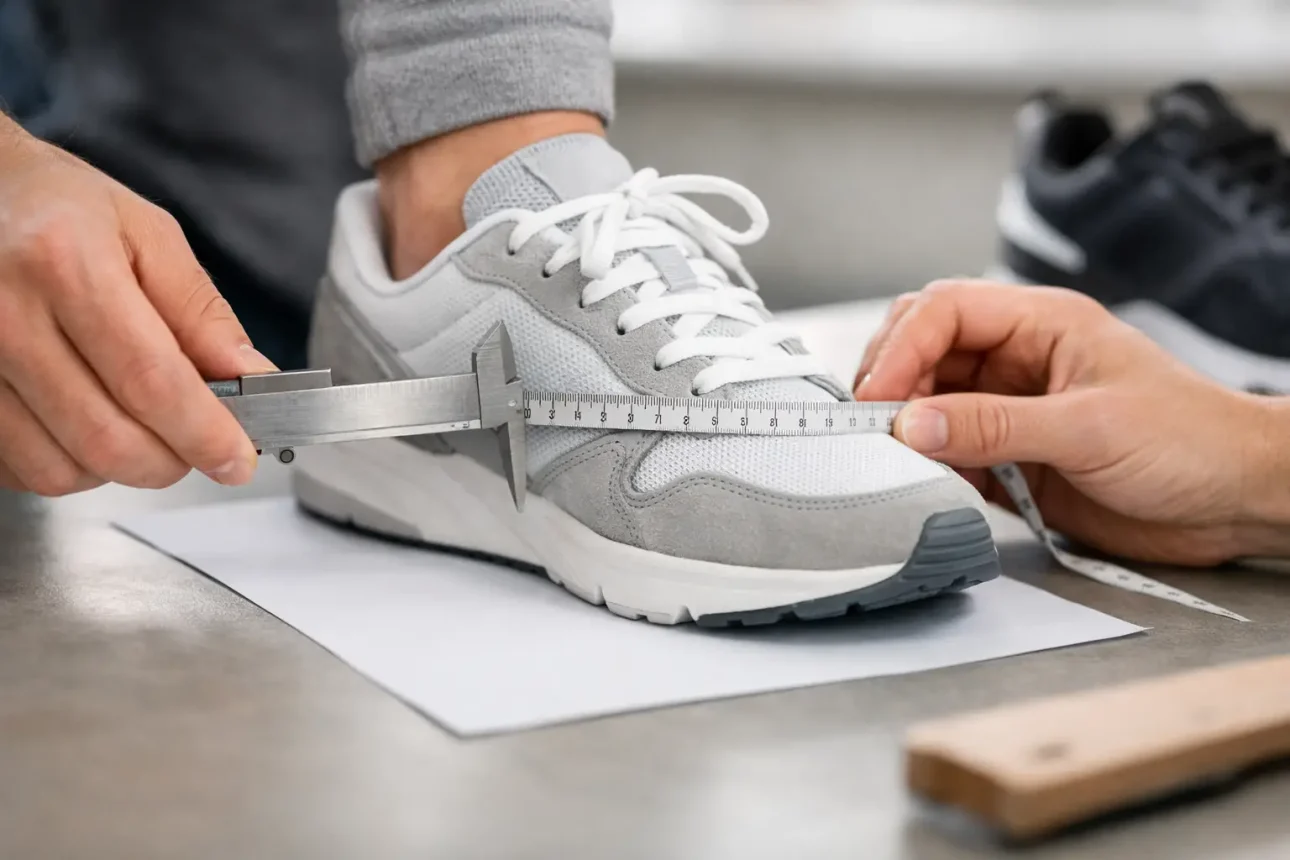
Your sneakers can be the right length and still feel terrible. That is usually a width problem. If you are figuring out how to find shoe width, do not guess from your usual size or assume every brand fits the same. Measure your feet, check the width code, and pay attention to how the shoe feels after you have been walking for a while.
A tight toe box can make a clean sneaker feel like a bad purchase fast. A shoe that is too wide can let your foot slide around, which is not much better. The goal is simple: enough room for your foot to spread naturally, without swimming inside the shoe.
You do not need fancy gear. Grab two sheets of paper, a pen or pencil, a ruler, and the socks you actually wear with sneakers. Do this later in the day if you can. Feet tend to get a little bigger after hours of standing, walking, commuting, or running around. Measuring first thing in the morning can leave you buying a pair that feels fine at breakfast and cramped by 5 p.m.
Put one sheet of paper against a wall on a hard floor. Stand on it with your heel lightly touching the wall. Keep your weight on both feet. Have someone trace around your foot if possible. Doing it yourself works, but it is easier to lean the pencil inward and make your foot look smaller than it is.
Measure the widest part of the outline. This is usually across the ball of your foot, around the area below your big toe and little toe. Write down the measurement. Then repeat the process with the other foot.
Use the larger measurement. Most people have one foot that is slightly longer or wider. Buying for the smaller foot is how people end up removing their shoes under the desk halfway through the day.
Width only makes sense next to length. A size 9 regular width is not the same physical width as a size 12 regular width. Shoe width charts use your foot length and ball-width measurement together to point you toward a width category.
Measure from the back of your heel to the longest toe. That longest toe is not always your big toe. For some people, the second toe sticks out farther. Add roughly a thumb’s width of space in front of that toe when checking the inside length of a sneaker. Your toes need room when you walk downhill, run, or stop suddenly.
If the length is right but the upper presses into the sides of your forefoot, do not automatically size up. That often gives you a shoe that is too long while still being wrong in the middle. Look for a wider width instead.
Width labels are not as friendly as shoe sizes. Brands use letters, and the labels can differ between men’s, women’s, and unisex shoes. Still, there is a useful baseline.
For men’s shoes, D is commonly standard or medium width. B is narrow. 2E is wide, and 4E is extra wide. You may also see EE instead of 2E.
For women’s shoes, B is commonly standard or medium width. AA is narrow, D is wide, and 2E is extra wide.
That does not mean every D or B fits exactly alike. A New Balance running shoe that comes in wide sizes may feel more generous through the forefoot than a fashion sneaker marked with the same width letter. Nike often runs more streamlined in many performance and lifestyle models. Hoka, Brooks, and New Balance tend to give shoppers more width choices in running and walking shoes. That is a pattern, not a law. Always check the specific model.
Unisex sneakers add another wrinkle. A unisex shoe often uses men’s sizing as the base. If you usually wear women’s sizing, read the size chart closely before choosing. The number conversion may be simple. The width can still feel different.
Your current shoes can tell you a lot, especially the pairs you have worn hard.
Look at the upper near your little toe. If it is stretched, bulging, or splitting out to the side, your forefoot likely needs more width. Check the insole too. If your foot print hangs over the edge, the platform is too narrow. Do not expect a new version of the same narrow shape to somehow break in perfectly.
Also look for excess creasing across the top of the shoe. This can mean the shoe is too wide or has too much volume for your foot. Width and volume are related, but they are not identical. A wide shoe gives more room side to side. A high-volume shoe gives more room over the top of the foot. Someone with a low instep can have a wide forefoot. Someone with a narrow foot can have a high instep. Shoe fit is annoyingly specific.
If your heel slips but the front feels tight, you may not need a wider shoe. You may need a different shape, a better heel lock with your laces, or a model with more room up front and a firmer heel cup. Sizing up is usually the lazy fix. It rarely fixes the real problem.
When your sneakers arrive, try them on indoors with the socks you plan to wear. Walk around for at least 10 minutes. Stand still. Go up and down a few stairs if you can. Your feet do not behave the same way when you are sitting on the edge of the bed.
The shoe should feel secure at the heel and midfoot. Your toes should be able to move, but your foot should not slide forward with every step. Across the ball of your foot, the upper should rest against your foot without pinching it.
Here are the signs to take seriously:
A little stiffness in a new upper is normal. Pain is not. Leather and some woven materials can relax a bit. Foam sidewalls, narrow toe boxes, and rigid overlays do not magically become roomy because you wore them for a week. If they hurt in your living room, skip them.
We see it all the time: someone says they are “always” a size 10, then buys three different brands and gets three different fits. Shoe sizes are a starting point, not a contract.
Use your measured foot length and width first. Then use the product’s size chart, the available width options, and the shape of the shoe. If you have a wider forefoot, a running shoe with a rounder toe box is often a better call than a sleek, narrow lifestyle sneaker. It may not look as sharp from every angle. It will feel better after a full day.
If you are between widths and the shoe comes in wide, we pick wide for walking, standing, and running. Your feet need space when they warm up. For a casual sneaker you wear for short trips, standard width may work if the upper is soft and the toe box is not restrictive. But do not make a shoe that only feels okay for 20 minutes your only pair.
A shoe store measurement device can give you a useful second opinion, especially if one foot feels consistently different from the other or you keep getting the fit wrong. Ask to be measured standing up, with both length and width checked. Then still try on the shoe. The device gives numbers. Your feet get the final say.
At Sneaker Loft, we would rather see you choose the width that works than force a popular silhouette that does not. A sneaker can look perfect in photos and still be a bad shoe for your day.
Measure both feet, use the larger one, and give your toes room to do their job. The right width is not a minor detail. It is the difference between sneakers you reach for every morning and sneakers that stay clean because you never want to wear them.